Artist stories
Through the Arch: a small window into a quieter world
A textured arch, yellow fabric curtains and a painted horizon: a closer look at the meeting of home and nature in S. Saima Afia’s Through the Arch.
Qurbart Studio · 31 October 2026 · 3 min read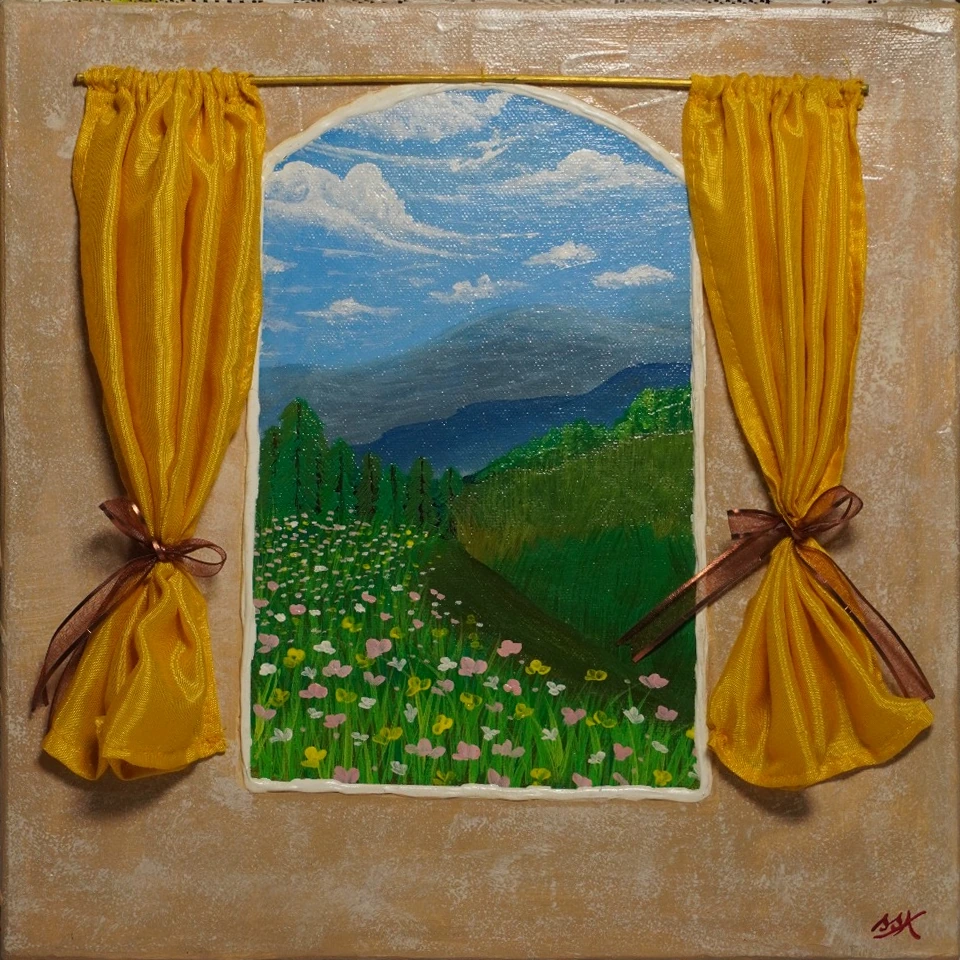
Begin with the window
A window can be a place to pause. Before thinking about the room beyond it, there is the act of looking: past the edge of a frame, across an open view, towards something that feels a little further away. Through the Arch makes that simple movement the centre of the work. It offers a painted landscape through a window that also has a physical presence on the canvas.
S. Saima Afia describes this painting as a tactile experiment in texture and perspective. The arch is hand-textured, and the yellow curtains are physical fabric. They surround a view of rolling hills, mountains and a colourful field of wildflowers. Those details matter because the work does not rely on a landscape alone. It brings the language of an interior into the painting itself.
Where fabric meets a painted horizon
Spend a moment with the curtains before moving towards the distance. Their folds belong to the indoor part of the scene. Beyond them, the horizon belongs to the painted outdoors. The meeting of these two kinds of surface is a useful way into the work: something close enough to imagine touching sits beside something that invites the eye to travel.
The artist’s statement explains this relationship directly. Physical fabrics and textures connect home comfort with wild nature. The arch is therefore more than an outline around a picture. It is the point at which two spaces meet. Looking at the work slowly allows those spaces to remain distinct while also becoming part of the same experience.
A peaceful view, and the question of privilege
Saima also connects the work to privilege: the luxury of waking up to a peaceful view. That gives the painting a question as well as a setting. What does it mean to have a place from which to look out in calm? The room, the curtains and the distant landscape hold that idea together without needing to turn the image into a literal view from a particular address.
The painting’s statement suggests that a sanctuary of calm can be created wherever someone finds themselves. This is the artist’s intention, rather than a promise that a painting will produce the same feeling for every person. A collector may notice the lightness of the curtains first; another may stay with the mountains or the wildflowers. There is room for those different encounters.
Looking beyond a single photograph
A photograph is a starting point for understanding a textured work. It helps to look at the whole composition and then return to details: the outline of the arch, the folds of the cloth, and the relationship between the foreground and the painted distance. Qurbart’s gallery includes photographs that let visitors spend more time with those material details.
If you are considering the work for your space, begin with the questions that brought you to it. Is it the imagined opening, the landscape, the colour of the curtains, or the artist’s idea of a personal sanctuary? Those observations can make a conversation about art more specific. They allow the painting to be considered as a particular work, with a particular intention, rather than simply as a way to fill an empty wall.
Sources & editorial note
Prepared by Qurbart Studio with AI assistance, grounded in the sources below. Artist statements belong to S. Saima Afia. Editorial text is not a personal statement from the artist.
Qurbart gallery and the artist’s statement for Through the Arch