Artist stories
Peace: the Palestinian symbols in Saima Afia’s painting
An orange branch, a cut watermelon and a few olives. In Peace, Saima paints a calm morning for Palestine, and the right to live one.
Qurbart Studio · 31 October 2026 · 3 min read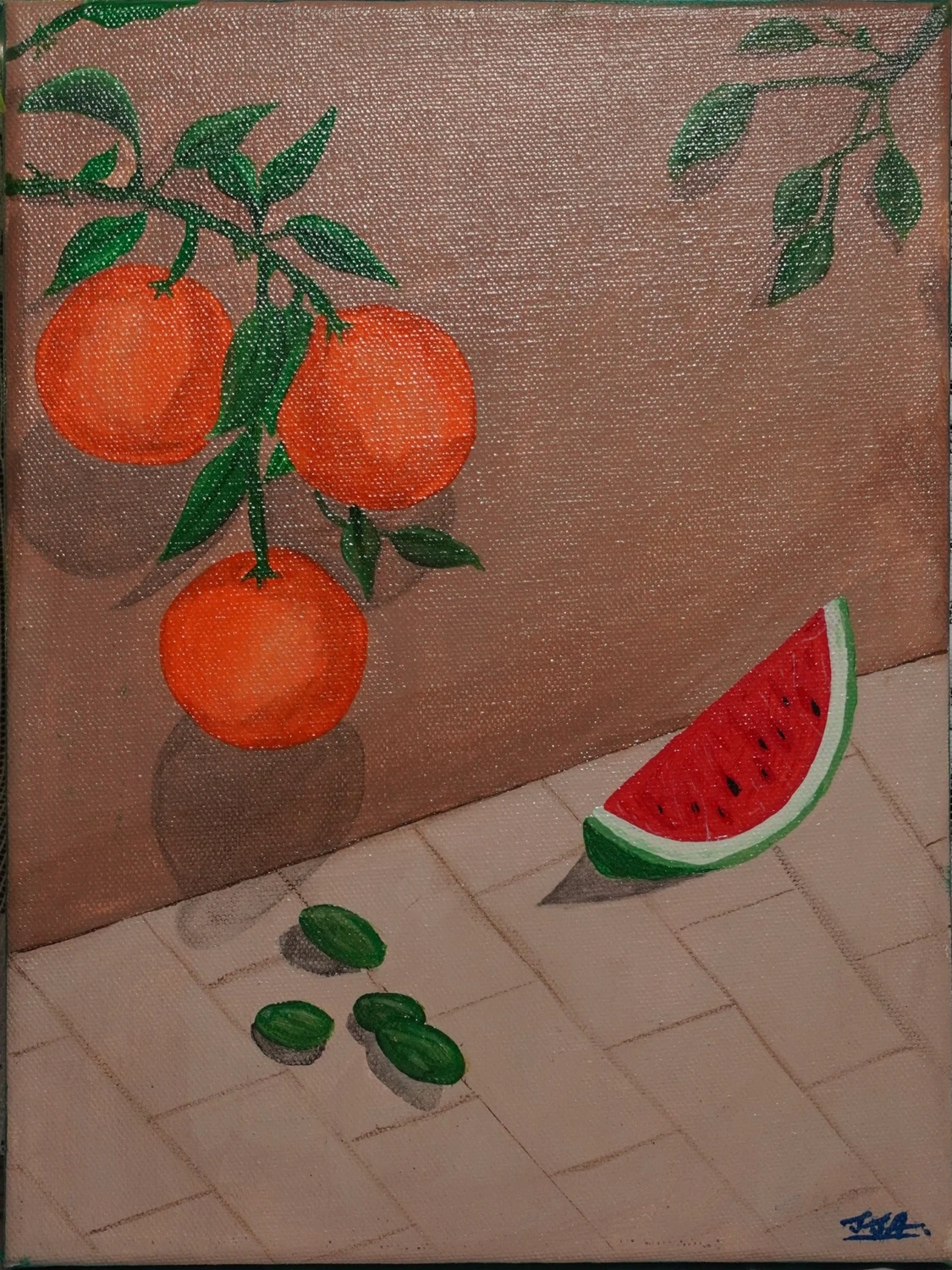
A morning that should be ordinary
Peace is Saima Afia’s painting for Palestine. Its oranges, watermelon and olives carry Palestinian stories of identity, land and belonging. But the scene she chooses is a simple one: fruit on a table, a branch bearing oranges, enough calm to sit down and eat.
In her artist’s note, Saima describes the day she wants the painting to hold: ‘a fresh morning and a calm day.’ Those few words bring the work close. This is not an imagined luxury. It is an ordinary morning that people should be able to have.
Look at the painting before reading further. The orange branch hangs into the scene from the left. A slice of watermelon rests on the table, with a few green olives nearby. Shadows fall beneath the fruit. The canvas texture remains visible across the warm background. There is time here to notice small things.
Why these three fruits?
Saima names the meaning of each element in the statement that accompanies Peace. She describes olive trees as a cornerstone of Palestinian life and an emblem of indigenous heritage. The few olives on the table therefore carry a connection to the land, even though a whole olive tree is not shown.
Her note connects the Jaffa orange with Palestinian resilience, agricultural skill and the loss of homeland during the 1948 Nakba. In the painting, the oranges are still attached to a leafy branch. They are part of a living plant, rather than objects separated from where they grew.
The watermelon brings another familiar symbol into the scene. Saima points to the red, green, white and black visible in a cut fruit: the colours of the Palestinian flag. Its meaning belongs beside the orange and the olives. Reading all three through her own note keeps their Palestinian context in view, rather than treating them as a collection of attractive shapes.
The quiet is part of the message
There is no figure seated at this table. The fruit is ready, and the scene leaves room to imagine the person who might share it. That is one way to spend time with the work: follow the painted shadows, notice the space between the olives, then return to the morning Saima describes.
The calm does not erase the subject. In her statement, Saima sets this scene against the violence Palestinians face. She paints what she hopes the situation could be. Knowing that intention changes how the still life reads. A piece of fruit can remain a piece of fruit and also stand for the chance to live, grow food and eat in peace.
Qurbart’s closeness to nature takes a particular form here. The plants and fruit belong to people, memory and home. Looking at their colour is one part of the encounter; making room for the meaning Saima gives them is another.
Stay with the painting
If Peace has stayed with you, read the full artist’s note on its painting page. It is the clearest place to hear Saima’s intention in her own words. The accompanying photographs also let you look at the original work beyond this single view.
You do not need to turn that response into a purchase. Take another look, share the artist’s note, or return to the detail that first caught your attention. The work asks for attention to an ordinary, peaceful life. That is worth leaving space for.
For a different story from the same studio, the Qurbart gallery brings together Saima’s paintings and the feelings behind them. If you are considering a painting about a place, memory or person of your own, the commission form is there when you are ready.
Sources & editorial note
Prepared by Qurbart Studio with AI assistance, grounded in the sources below. Artist statements belong to S. Saima Afia. Editorial text is not a personal statement from the artist.
Peace — painting and artist’s statement by S. Saima Afia